

Oil and gas companies now manage more data than ever before. Wells, pipelines, tanks, and drilling rigs generate data every hour. Without an effective system to collect and organize this information, teams lose time, miss compliance deadlines, and risk making decisions based on outdated reports.
This article explains what oil and gas data management software does, how much it costs to build or buy, the expected return, and the steps involved in development. Charts are included to help you quickly review cost and market data.
What Is Oil and Gas Data Management Software?
Oil and gas data management software is designed to collect, store, organize, and report data from all stages of operations. It handles exploration data such as seismic surveys, drilling data from rig sensors, production numbers from wells, and compliance records needed for regulators.
The software gathers data from sources like SCADA systems, IoT sensors on equipment, and manual field entries. It cleans and stores this data in one place, then creates reports for engineers, managers, and regulators.

Common users include:
- Field engineers who log daily production numbers
- Geologists who review well and reservoir data
- Compliance officers who file reports with regulators
- Executives who track cost and output across multiple sites
Without this software, most work is still done in spreadsheets and paper logs. This method quickly becomes unmanageable as a company grows beyond a few wells.
Why Data Management Matters in Oil and Gas?
The oil and gas industry runs on numbers, and the volume keeps growing. Research from Precision Reports found the sector now handles more than 2.5 petabytes of seismic, drilling, and production data every year, with over 65% of oilfield operations already relying on data-driven decision systems. That same research found more than 70 percent of exploration projects now use advanced analytics to improve reservoir modeling, and over 75% of US shale operators use advanced data platforms to optimize production.
Field-level adoption is also increasing. Around 68% of drilling operations in the Permian Basin already use real-time data analytics systems. This is not just a future trend, it is now standard practice for operators getting the most value from their wells.
Business Research Insights found a similar trend across the industry. About 68% of oil and gas companies are adopting automation and analytics software to improve operations and decision-making. However, nearly 42% report cybersecurity and data integration issues that slow down software rollouts on older systems. This gap between adoption and integration is where a strong data management system proves its value.
The software segment of the data management market is growing faster than hardware or services. IndustryARC expects the software side of oil and gas data management to grow by nearly 16 percent per year through 2028, driven by demand for AI tools, business intelligence, and large-scale data processing.
Poor data management leads to real costs. Companies that depend on spreadsheets and manual entry face:
- Delayed or inaccurate regulatory filings, which can lead to fines
- Lost production revenue from allocation errors between wells and tanks
- Slower response to equipment failure because data sits in separate systems
- Duplicate work across departments pulling the same numbers from different sources
Market size, 2025 to 2030
Global oil and gas data management market, in billions of US dollars
Cost of Oil and Gas Data Management Software
Cost depends largely on the project scope. A basic tool for one field office costs much less than a full enterprise platform connected to SCADA systems across many wells. Below is a breakdown of what affects price and what you can expect to pay at each stage.
What Drives the Cost
Development cost by project tier
Typical cost range in US dollars, by project scope
- Number and complexity of features: A system that only tracks production numbers costs less than one that also handles drilling data, compliance reporting, and equipment maintenance.
- Custom build versus off-the-shelf platform: Buying and configuring an existing platform costs less upfront than building from scratch, but it may not fit unique workflows and often includes ongoing license fees.
- Integration needs: Connecting to SCADA systems, WITSML drilling feeds, or an existing ERP like SAP adds significant cost. Each integration point requires its own testing and maintenance plan.
- Team location and structure: Hourly rates differ widely by region. Keyhole Software’s 2026 benchmark data, based on over 200 projects, shows US-based senior developers charge $125 to $250 or more per hour. Central and Northern European teams charge $50 to $95 per hour and have strong GDPR compliance experience. Offshore teams in South Asia and Latin America usually cost less, though their rates are rising as demand increases.
Rough Cost Ranges by Project Type
| Project Type | Typical Cost Range | What It Covers |
| MVP or basic version | $30,000 to $80,000 | Core production tracking, basic reporting, single site |
| Mid-size custom platform | $80,000 to $300,000 | Multi-site tracking, SCADA integration, compliance reporting |
| Enterprise-level system | $300,000 to $750,000+ | Full integration across drilling, production, compliance, and finance, plus predictive analytics |
These ranges match broader software industry data. A 2026 industry review found that custom software projects usually cost from about $30,000 for simple internal tools to $750,000 or more for complex enterprise platforms. The average project costs around $132,480 and takes about 13 months to finish.
Oil and gas projects are often at the higher end of these ranges because they require integration with field hardware and must meet strict compliance requirements for drilling and emissions reporting.
Hidden Costs to Plan For
Many budgets overlook costs that appear after launch. Be sure to plan for:
- Hosting and infrastructure. Cloud storage costs scale with the amount of sensor and production data collected.
- Maintenance and updates. Software needs regular patches, especially anything connected to SCADA or IoT devices.
- Training. Field teams and office staff need time to learn the new system, and this training comes with real costs in lost productivity during rollout.
- Compliance updates. Regulations change, and reporting modules need updates to stay current.
- Scope creep. A 2026 cost analysis found that unclear project requirements are the main cause of cost overruns, leading to about 32 percent of software project failures. More than half of all software projects go over budget by at least 89 percent. Defining requirements early is the best way to protect your budget.
Suggested visual: A simple horizontal bar chart comparing the three cost tiers (MVP, mid-size, enterprise) side by side, so readers can visually compare scope against price.
Return on Investment (ROI)
Software is only worthwhile if it pays for itself. For oil and gas data management systems, the return usually comes from four main areas.
1. Time Saved on Manual Data Entry
Field staff and analysts spend hours each week gathering numbers from different logs and spreadsheets. A connected system collects this data automatically from SCADA and IoT sources, freeing up staff for higher-value work like analysis and planning instead of manual data entry.
2. Fewer Errors in Compliance Reporting
Manual reporting increases the risk of mistakes, and errors in regulatory filings can result in fines or delayed permits. A system with built-in validation rules catches errors before they reach regulators, protecting both finances and reputation.
3. Better Production Decisions
Real-time production data helps engineers identify underperforming wells more quickly. Instead of learning about a decline weeks later in a monthly report, teams can respond within days. This directly protects revenue that might otherwise be lost due to slow response.
4. Reduced Downtime from Predictive Insights
Equipment failure is costly, both in repairs and lost production during downtime. Predictive maintenance features identify equipment issues early, using patterns in sensor data. This allows maintenance to be planned instead of reactive, which usually costs less.
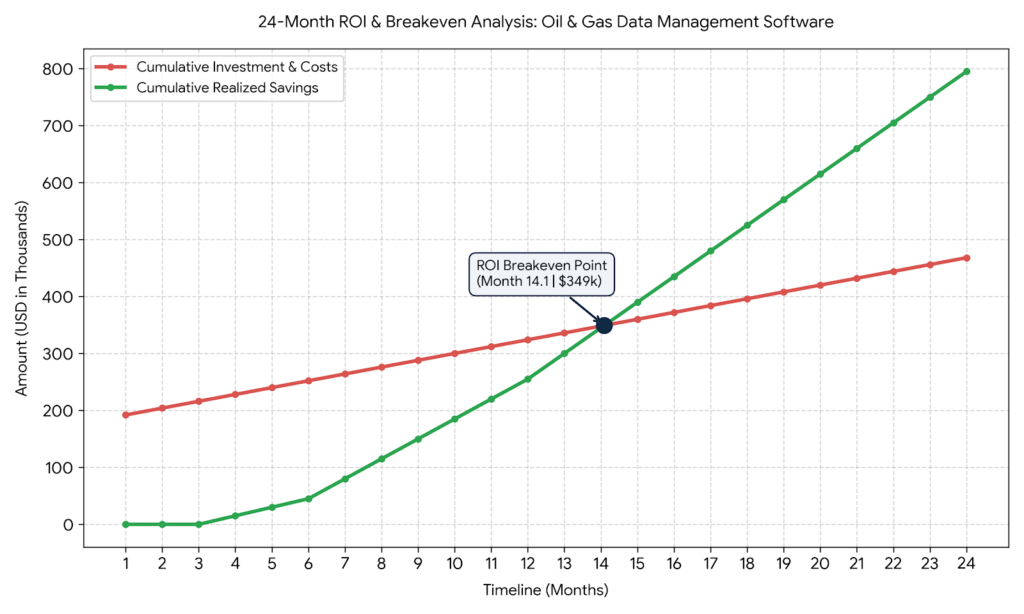
5. A Simple Way to Estimate ROI
A basic framework looks like this:
ROI = (Value gained from efficiency, fewer errors, and reduced downtime) – (Total cost of the software) / Total cost of the software
For example, a mid-size operator with 40 wells might spend $150,000 on a custom platform. If the platform saves 10 hours a week in manual reporting, prevents two compliance errors a year that would have cost $20,000 each in fines, and reduces unplanned downtime by a few days a year, the value gained can exceed the software cost within 18 to 24 months. Every operation is different, so it is helpful to model this with your own numbers before starting a build.
Development Process of oil and gas data management software – Step by Step
Building oil and gas data management software usually follows a standard process, though the details vary depending on the project scope.
Typical path for building oil and gas data management software
Discovery and requirement gathering
Meet with field staff, engineers, and management to map out what data needs tracking and which systems need to connect.
Choosing MVP vs full scope
Decide whether to start with a minimum viable product covering core features first, or build the full system at once.
Design and data architecture
Plan how data flows from field sensors to the database to the reports users see. Good design here prevents costly rework later.
Development and integration
Build the core software and connect it to SCADA systems, ERP platforms, and other data sources. Usually the most time-consuming step.
Testing and compliance checks
Test for accuracy, security, and speed, including checks that compliance reports match the exact format regulators require.
Deployment and team training
Roll out the software, often starting with a pilot group, and train field and office staff on the new workflow.
Ongoing support and updates
Provide regular maintenance, security patches, and updates as regulations or business needs change.
A typical mid-size project takes between six and thirteen months from discovery to launch, depending on the number of integrations and the amount of custom reporting required.
In-House vs Outsourced Development
Companies usually choose between building an internal development team or outsourcing to a software partner. Each option has its own trade-offs.
In-House Development
Pros:
- Full control over priorities and timelines
- Deep, built-up knowledge of your own systems over time
- Easier day-to-day communication with the team
Cons:
- Higher fixed cost, since you pay full salaries and benefits year-round
- Harder to find developers with both software skills and oil and gas domain knowledge
- Slower to scale up or down as project needs change
Outsourced Development
Pros:
- Lower cost in most regions, since offshore and nearshore rates run well below US in-house salaries
- Access to teams who already have experience in oil and gas or similar regulated industries
- Faster to scale the team up for a big push or down once the build is done
Cons:
- Less day-to-day control, especially across time zones
- Requires strong documentation and communication to avoid misunderstandings
- Quality varies a lot between vendors, so vetting matters
A 2026 outsourcing cost analysis found that companies can save up to 40 percent by outsourcing development, but only if they choose the right destination and partner. The same research warns that comparing hourly rates alone can be misleading. A very low hourly rate for a senior developer often means the role, location, or experience level is not as advertised. A real senior nearshore developer usually costs $80 to $120 per hour when properly staffed.
For most mid-size oil and gas operators, a hybrid model works well. This means having a small in-house team that understands the business, paired with an outsourced partner who handles most of the development work.
How to Choose the Right Development Partner?
Choosing the right software development partner affects the final cost and quality more than almost any other decision. Here are a few questions to ask before signing a contract:
- Have they built software for oil and gas or another regulated, data-heavy industry before?
- Can they show examples of past SCADA, WITSML, or ERP integrations?
- What is their process for handling scope changes mid-project?
- Do they offer ongoing support after launch, or only the initial build?
- How do they handle data security, especially for sensitive well and reservoir data?
Red flags to watch for:
- Quotes that seem far below market rate with no clear explanation
- Vague answers about past industry experience
- No clear plan for testing or compliance review
- Reluctance to put timelines and deliverables in writing
Industry experience is especially important in oil and gas because compliance rules, integration standards like WITSML, and field hardware are specialized. A team without industry experience will spend your budget learning what an experienced partner already knows.
Key Takeaways
Oil and gas data management software can cost from $30,000 for a basic MVP to $750,000 or more for a full enterprise platform. Costs are mainly driven by integration needs and feature scope. The return comes from time saved, fewer compliance errors, better production decisions, and less downtime. Most well-planned projects show positive ROI within the first two years.
The development process follows a clear path: discovery, MVP scoping, architecture, build, testing, deployment, and ongoing support. Companies can build in-house, outsource, or use a mix of both. The best choice depends on budget, timeline, and how much control the team wants.
No matter which path you choose, defining requirements early and selecting a partner with real oil and gas experience will protect your budget more than any other decision.